Digital Classicist London seminar 2017 programme

Institute of Classical Studies

Senate House, Malet Street, London WC1E 7HU

Fridays at 16:30 in room 234*

Jun 2 Sarah Middle (Open University) Linked Data and Ancient World Research: studying past projects from a user perspective
Jun 9 Donald Sturgeon (Harvard University) Crowdsourcing a digital library of pre-modern Chinese
Jun 16* Valeria Vitale et al. (Institute of Classical Studies) Recogito 2: linked data without the pointy brackets
Jun 23* Dimitar Iliev et al. (University of Sofia “St. Kliment Ohridski”) Historical GIS of South-Eastern Europe
Jun 30

&

Lucia Vannini (Institute of Classical Studies) The role of Digital Humanities in Papyrology: Practices and user needs in papyrological research

Paula Granados García (Open University) Cultural Contact in Early Roman Spain through Linked Open Data resources

Jul 7 Elisa Nury (King’s College London) Collation Visualization: Helping Users to Explore Collated Manuscripts
Jul 14 Sarah Ketchley (University of Washington) Re-Imagining Nineteenth Century Nile Travel & Excavation for a Digital Age: The Emma B. Andrews Diary Project
Jul 21 Dorothea Reule & Pietro Liuzzo (Hamburg University) Issues in the development of digital projects based on user requirements. The case of Beta maāḥǝft
Jul 28 Rada Varga (Babeș-Bolyai University, Cluj-Napoca) Romans 1by1: Transferring information from ancient people to modern users

*Except Jun 16 & 23, room G34

digitalclassicist.org/wip/wip2017.html

This series is focussed on user and reader needs of digital projects or resources, and assumed a wide definition of classics including the whole ancient world more broadly than only the Greco-Roman Mediterranean. The seminars will be pitched at a level suitable for postgraduate students or interested colleagues in Archaeology, Classics, Digital Humanities and related fields.

Digital Classicist London seminar is organized by Gabriel Bodard, Simona Stoyanova and Valeria Vitale (ICS) and Simon Mahony and Eleanor Robson (UCL).

ALL WELCOME

Posted in Digitalclassicist admin, seminar, Teaching | Leave a comment

Unlocking Sacred Landscapes, by Giorgos Papantoniou

Project report by Dr Giorgos Papantoniou, papantog@uni-bonn.de

Previous multi-dimensional approaches to the study of ancient Mediterranean societies have shown that social, economic and religious lives were closely entwined. In attempting to engage with Cyprus’s multiple identities – and the ways in which islanders may have negotiated, performed or represented their identities – several material vectors related to ritual and sacred space must be taken into consideration. The sharp modern distinction between sacred and profane is not applicable to antiquity, and the terms ritual, cult and sacred space in Unlocking Sacred Landscapes: Cypriot Sanctuaries as Economic Units are used broadly to include the domestic and funerary spheres of life as well as formally constituted sanctuaries. Perceiving ritual space as instrumental in forming both power relations and the worldview of ancient people, and taking ancient Cyprus as a case study, the Project aims at elucidating how meanings and identities were diachronically expressed in, or created by, the topographical and economic setting of ritual and its material depositions and dedications.

The evidence of cult or sacred space is very limited and ambiguous before the Late Bronze Age. During the Late Bronze Age (ca. 1700-1125/1100 BC), however ritual spaces were closely linked to industrial activities; the appropriation, distribution, and consumption of various resources (especially copper), labour and land was achieved by the elite through exploitation of supernatural knowledge. The Early Iron Age (ca. 1125/1100-750 BC) landscapes are very difficult to approach. We can, however, identify sanctuary sites in the countryside towards the end of this period. This phenomenon might well relate to the consolidation of the Iron Age Cypriot polities (known in the archaeological literature as Cypriot city-kingdoms) and their territories. While urban sanctuaries become religious communal centres, where social, cultural and political identities are affirmed, an indication of the probable use of extra-urban sanctuaries in the political establishment of the various polities of the Cypro-Archaic (ca. 750-480 BC) and Cypro-Classical (ca. 480-310 BC) periods has recently been put forward.

During the Hellenistic period (ca. 310-30 BC), a process of official neglect of the extra-urban sanctuaries signals a fundamental transformation in the social perception of the land. After the end of the city-kingdoms, and the movement from many political identities to a single identity, extra-urban sanctuaries were important mainly to the local extra-urban population. By the Roman period (ca. 30 BC-330 AD), the great majority of Hellenistic extra-urban sanctuaries are ‘dead’. When the social memory, elite or non-elite, that kept them alive ‘dies’, they ‘die’ with it; what usually distinguishes the surviving sites is what the defunct sites lacked: political scale and significance. As the topography of Roman sanctuary sites reveals, this is not to say that extra-urban sanctuaries did not exist anymore. Over time, however, they started to become primarily the concern of local audiences. The annexation and ‘provincialisation’ of Cyprus, with all the consequent developments, were accompanied by changes in memorial patterns, with less focus on regional or local structures, and more intense emphasis on stressing an ideology which created a more widely recognisable ‘pan-Cypriot’ myth-history, which was eventually related to Ptolemaic, and later to Roman imperial power and ideology.

This Project puts together a holistic, inter-disciplinary approach to the diachronic study of the ancient Cypriot ritual and cult. While it aims at bringing together textual, archaeological, epigraphic, art-historical, and sociological/anthropological evidence, for the first time it incorporates ‘scientific’ spatial analysis and more agent-centred computational models to the study of ancient Cypriot sanctuaries and religion. By inserting in a GIS environment the Cypriot sanctuary sites the relation of sacred landscapes with politico-economic geography put forward above is tested both at regional and at island-wide level.

The Project falls under the umbrella of a larger Research Network entitled Unlocking Sacred Landscapes.

For further information: http://www.ucy.ac.cy/unsala/

Dr Giorgos Papantoniou
Research Training Group 1878: Archaeology of Pre-Modern Economies
Rheinische Friedrich-Wilhelms-Universität Bonn
Institut für Archäologie und Kulturanthropologie
Abteilung für Klassische Archäologie
Lennéstr. 1
D-53113, Bonn
Germany

Posted in Projects | Tagged | Leave a comment

Job advertisement: Postdoctoral Research Associate (KCL)

Posted on behalf of Will Wootton (to whom enquiries should be addressed):

Training in Action: From Documentation to Protection of Cultural Heritage in Libya and Tunisia

As part of this new project funded by the British Council’s Cultural Heritage Protection Fund, a Post-Doctoral position will be employed at King’s College London. The Research Associate will work on the project initially for 10 months, with the contract likely to be renewed for a further 12 months.

The deadline for applications is 10th May. For further information, see here:
https://www.hirewire.co.uk/HE/1061247/MS_JobDetails.aspx?JobID=76726
And here:
http://www.jobs.ac.uk/job/BAY043/post-doctoral-research-associate-on-training-in-action-from-documentation-to-protection-of-cultural-heritage-in-libya-and-tunisia/

We would be most grateful if you could circulate this email to interested parties as the deadline is imminent.

Dr Will Wootton
King’s College London,London WC2R 2LS.
Tel. +44 (0)207 848 1015
Fax +44 (2)07 848 2545

Posted in Jobs, Projects | Leave a comment

Open Epigraphic Data Unconference, London, May 15, 2017

Open Epigraphic Data Unconference
10:00–17:00, May 15, 2017, Institute of Classical Studies

This one-day workshop, or “unconference,” brings together scholars, historians and data scientists with a shared interest in classical epigraphic data. The event involves no speakers or set programme of presentations, but rather a loose agenda, to be further refined in advance or on the day, which is to use, exploit, transform and “mash-up” with other sources the Open Data recently made available by the Epigraphic Database Heidelberg under a Creative Commons license. Both present and remote participants with programming and data-processing experience, and those with an interest in discussing and planning data manipulation and aggregation at a higher level, are welcomed.

Places at the event in London are limited; please contact <gabriel.bodard@sas.ac.uk> if you would like to register to attend.

There will also be a Google Hangout opened on the day, for participants who are not able to attend in person. We hope this event will only be the beginning of a longer conversation and project to exploit and disseminate this invaluable epigraphic dataset.

Posted in EpiDoc, Events, Open Access, Open Source, Projects | Leave a comment

Historia Ludens: Conference on History and Gaming, 19 May 2017

Posted on behalf of Alexander von Lünen (to whom queries should be addressed):

University of Huddersfield
19 May 2017

This conference follows up on the workshop “Playing with History” that has been held in November 2015 in Huddersfield. Gaming and History is gaining more and more traction, either as means to “gamify” history education or museum experiences, or as computer games as prism into history like the popular History Respawned podcast series (http://www.historyrespawned.com/).

Besides discussing gamification or using (computer) games, we also want to explore gaming and playing in a broader historical-cultural sense. Can “playing” be used as category for historical scholarship, maybe alongside other categories such as gender, space or class? Historian Johan Huizinga’s Homo Ludens from 1938 looked at play and its importance for human culture. Can historians make similar cases for more specific histories? In recent publications historians have pointed to the connection between cities and play. Simon Sleight, for example, has worked on the history of childhood and urban history, i.e. young people appropriating public urban spaces for their ludic activities and their struggle with authorities over this. Archaeologists, as another example, have shown that much of the urban infrastructure of Ancient Rome was dedicated to games, playing and gambling, as it had such a big role in Roman life.

The conference will thus discuss terms like “gaming”, “playing” and “history” in broad terms. There are academic papers in the morning and round-table sessions in the afternoon for networking and demos.

Tickets (£10) are available via the University of Huddersfield web shop. Please note: there are travel/conference bursaries for postgraduate students available on request; please contact Dr Alexander von Lünen (a.f.vonlunen@hud.ac.uk) for details.

Full details and programme at https://hudddighum.wordpress.com/2017/03/06/historia-ludens-conference-on-history-and-gaming-19-may-2017/

Posted in Conferences | Leave a comment

CFP: Cyborg Classics: An Interdisciplinary Symposium

Forwarded on behalf of Silvie Kilgallon (to whom enqueries should be addressed):

We are pleased to announce a one-day symposium, sponsored by BIRTHA (The Bristol Institute for Research in the Humanities and Arts) to be held at the University of Bristol, on Friday July 7th 2017.

Keynote speakers:

  • Dr Kate Devlin (Goldsmiths)
  • Dr Genevieve Liveley (Bristol)
  • Dr Rae Muhlstock (NYU)

The aim of the day is to bring together researchers from different disciplines – scholars in Archaeology & Anthropology, Classics, English, History, and Theology as well as in AI, Robotics, Ethics, and Medicine – to share their work on automata, robots, and cyborgs. Ultimately, the aim is an edited volume and the development of further collaborative research projects.

Indicative key provocations include:

  • To what extent do myths and narratives about automata, robots, and cyborgs raise questions that are relevant to contemporary debates concerning robot, cyborg, and AI product innovation?
  • To what extent, and how, can contemporary debate concerning robot, cyborg, and AI product innovation rescript ancient myths and narratives about automata, robots, and cyborgs.
  • Can interdisciplinary dialogues between the ‘soft’ humanities and the ‘hard’ sciences of robotics and AI be developed? And to what benefit?
  • How might figures such as Pandora, Pygmalion’s statue, and Talos help inform current polarized debates concerning robot, cyborg, and AI ethics?
  • What are the predominant narrative scripts and frames that shape the public understanding of robotics and AI? How could these be re-coded?

We invite scholars working across the range of Classics and Ancient History (including Classical Reception) and across the Humanities more widely to submit expressions of interest and/or a title and abstract (of no more than 250 words) to the symposium coordinator, Silvie Kilgallon (silvie.kilgallon@bristol.ac.uk). PhD students are warmly encouraged to contribute. The deadline for receipt of abstracts is May 31st, 2017.

Posted in Call for papers | Leave a comment

Research Fellows: Latinization of the north-western provinces

Posted on behalf on Alex Mullen (to whom enquiries should be addressed):

I should like to draw your attention to the advertisement for 2 Research Fellows for the 5-year ERC project: the Latinization of the North-Western Provinces: Sociolinguistics, Epigraphy and Archaeology (LatinNow).

The RFs will be based at the Centre for the Study of Ancient Documents, University of Oxford, and will start, at the earliest, in September 2017. The positions will be for 3 years, with the possibility of extension.

Although the RFs will be located in Oxford, their contracts will be with the project host, the University of Nottingham, so applications must be made via the Nottingham online system:

https://www.nottingham.ac.uk/jobs/currentvacancies/ref/ART002017

Please note that the panel requires basic details to be filled in online and a CV and covering letter to be uploaded (apologies, the generic application system is not clear on what needs to be uploaded). The deadline for applications is the 14th April.

If you would like further information, please do not hesitate to contact the Principal Investigator, Dr Alex Mullen.

Posted in EpiDoc, Jobs | Leave a comment

Roman Society Summer Placements

The Roman Society is pleased to invite applications for its 2017 bursary scheme.  The placements may be held at the following museums / organisations:

Ashmolean Museum, Oxford: http://www.ashmolean.org/

Roman Baths, Bath: http://www.romanbaths.co.uk/

British Museum, Department of Greece and Rome: http://www.britishmuseum.org/

British Museum, Department of Coins and Medals: http://www.britishmuseum.org/

Corbridge Roman Site: http://www.english-heritage.org.uk/daysout/properties/corbridge-roman-town-hadrians-wall/

The placement will involve supporting the curatorial team in their collections research for the upcoming re-interpretation project at Corbridge museum. The exact nature of the work will depend on the applicant’s interests and experience, and the stage of current work at the time of the placement.

Great North Museum, Newcastle-Upon-Tyne: https://greatnorthmuseum.org.uk/

English Heritage, Properties Historians Team, London: http://www.english-heritage.org.uk/

The successful candidate will have the opportunity to complete three different tasks: 1) historical research on an aspect of Roman history, including life in a Roman town, the history of Roman military installations and early-modern / modern literary responses to Roman sites; 2) the interpretation of historical material to the public, including the preparation of display panels, trails and reconstruction drawings; 3) shadowing a historian at project meetings and helping to prepare project documents. These examples are indicative and the exact of the nature of the placement programme will be determined by its timing, project requirements, and a discussion with the candidate.

Institute of Classical Studies: http://ics.sas.ac.uk/

This placement offers the opportunity to gain experience in digital classics research. The successful candidate will have the opportunity to design and implement a small, independent piece of work related to one of the Institute’s projects, for example: a database of persons or names related to a historical source or area; annotating geographical information in visual or textual resources; or library catalogue data related to digital publication. Advanced digital skills are not a requirement, but familiarity with basic tools such as spreadsheets and database tables would be an advantage.

  •  The dates of the placement may be determined by consultation between the successful candidates and institutions but are usually for 2-3 weeks during the summer vacation.
  • All Undergraduate and MA students are eligible to apply.
  • Up to eight bursaries of £250 will be offered as a contribution towards travel or living expenses.
  • Candidates should apply by letter setting out their reasons for wishing to undertake an internship and outlining any previous experience.  You should also provide the name and email address of a referee.
  • You may specify the Museum / organisation you would prefer to be based at, or submit an open application.
  • Queries and letters of application should be addressed to the Secretary, Dr Fiona Haarer, and sent by email by 30 April, 2017 to: office@romansociety.org
Posted in Projects, Teaching | Tagged , , | Leave a comment

Cataloguing Open Access Classics Serials

The Institute for Classical Studies is pleased to announce the appointment of Simona Stoyanova for one year as a new Research Fellow in Library and Information Science on the Cataloguing Open Access Classics Serials (COACS) project, funded by a development grant from the School of Advanced Study.

COACS will leverage various sites that list or index open access (OA) publications, especially journals and serials, in classics and ancient history, so as to produce a resource that subject libraries may use to automatically catalogue the publications and articles therein. The project is based in the ICS, supervised by the Reader in Digital Classics, Gabriel Bodard, and the Combined Library, with the support of Paul Jackson and Sue Willetts. Other digital librarians and scholars including Richard Gartner and Raphaële Mouren in the Warburg Institute; Patrick Burns and Tom Elliott from the Institute for the Study of the Ancient World (NYU); Charles Jones from Penn State; and Matteo Romanello from the German Archaeological Institute are providing further advice.

Major stages of work will include:

  1. Survey of AWOL: We shall assess the regularity of metadata in the open access journals listed at AWOL (which currently lists 1521 OA periodicals, containing a little over 50,000 articles), and estimate what proportion of these titles expose metadata in standard formats that would enable harvesting in a form amenable to import into library catalogues. A certain amount of iteration and even manual curation of data is likely to be necessary. The intermediate dataset will need to be updated and incremented over time, rather than overwritten entirely on each import.
  2. Intermediate data format: We will also decide on the intermediate format (containing MARC data), which in addition to being ingested by the Combined Library will be made available for use by other libraries (e.g. NYU Library and the German Archaeological Institute’s Zenon catalogue). The addition of catalogued OA serials and articles to the library catalogue will significantly contribute to the research practice of scholars and other library users, enabling new research outputs from the Institute and enhancing the open access policy of the School.
  3. Further OA indexes: Once the proof-of-concept is in place, and data is being harvested from AWOL (and tested that they update rather than overwriting or duplicating pre-existing titles), we shall experiment with harvesting similar data from other indexes of OA content, such as DOAJ, OLH, Persée, DialNet, TOCS-IN, and perhaps even institutional repositories.
  4. Publish open access software: All code for harvesting OA serials and articles, and for ingest by library catalogues will be made available through Github. This code will then be available for updating the intermediate data to take advantage of new titles that are added to AWOL and other resources, and new issues of serials that are already listed. This will enable reuse of our scripts and data by other libraries and similar institutions.

By the end of the pilot project, we will have: made available and documented the intermediate dataset and harvesting and ingest code; performed a test ingest of the data into the ICS library catalogue; engaged known (NYU, Zenon, BL) and newly discovered colleagues in potentially adding to and using this data; explored the possibility of seeking external funding to take this project further.

We consider this project to be a pilot for further work, for which we intend to seek external funding once a proof of concept is in place. We hope to be able to build on this first phase of work by: extending the methods to other disciplines, especially those covered by the other institute libraries in SAS; enabling the harvest of full-text from serials whose license permit it, for search and other textual research such as text-mining and natural language processing; disambiguating enhancing the internal and external bibliographical references to enable hyperlinks to primary and secondary sources where available.

Posted in Digital library, Open Access, Open Source, Projects | 2 Comments

Yale University Library seeks Digital Scholarship Project Manager

Yale University offers exciting opportunities for achievement and growth in New Haven, Connecticut. Conveniently located between Boston and New York, New Haven is the creative capital of Connecticut with cultural resources that include two major art museums, a critically-acclaimed repertory theater, state-of-the-art concert hall, and world-renowned schools of Architecture, Art, Drama, and Music.

Position Focus: Yale University seeks a Project Manager (PM) who will be responsible for coordination and completion of projects for Digital Scholarship Services (DSS) in the Yale University Library. This position will oversee all aspects of digital scholarship project management by setting deadlines, assigning responsibilities, and monitoring and summarizing progress of projects. The PM will prepare reports for upper management regarding status of projects and be familiar with a variety of digital scholarship concepts, practices, and procedures. Relying on experience and judgment, the PM will plan and accomplish goals by performing a variety of tasks across a spectrum of technologies and digital services. A wide degree of creativity and latitude is expected. Reports to the Director of Digital Scholarship Services.
Continue reading

Posted in Jobs | Tagged , | Leave a comment

CFP: Digital Textual Editions and Corpora

Digital Classics Association
Call for papers for the January 4-7, 2018 meeting of the Society for Classical Studies in Boston

“Digital Textual Editions and Corpora”

Organizer: Neil Coffee, University at Buffalo, SUNY ncoffee@buffalo.edu

The discovery, editing, and publication of classical texts has been a foundational activity in the study of antiquity. The creation of born-digital editions of classical texts and of digital textual corpora has led to a resurgence of interest in the curation and editing of texts, so that they can be made more broadly accessible online and enhanced with features only possible through digital representation. The aim of this panel is to inform the SCS membership and engage them in a discussion regarding the current state of the art in the curation and publication of digital editions and corpora, as well as likely future directions. Abstracts are invited in two complementary areas. Scholars with experience working with contemporary digital editions and corpora are invited to discuss their experience. This might involve creating a digital edition or corpus, or it might involve a research project that intensively engaged with one. Scholars who have set up digital corpora and/or editing environments, or who work on conventions or other software that underlie such corpora are invited to relate their experience as well. Papers can address completed work, but can also be devoted partly or entirely to ongoing work, problems, or challenges.

Anonymous abstracts of no more than 400 words should be sent to digitalclassicsassociation@gmail.com, with identifying information in the email. Abstracts will be refereed anonymously in accordance with SCS regulations. Submitters should confirm in their emails that they are SCS members in good standing. Abstracts should follow the formatting guidelines of the instructions for individual abstracts on the SCS website. The deadline for the submission of abstracts is March 1, 2017.

SCS website version: https://goo.gl/m21JQG

Posted in Call for papers | Leave a comment

Digital Classicist London 2017 CFP

The Digital Classicist London seminar invites proposals with a focus on the needs of users/readers, for the summer 2017 season, which will run on Friday afternoons in June and July in the Institute of Classical Studies, Senate House, London.

We welcome proposals in any area of classics, including ancient history, archaeology and reception, that employ digital or other innovative and collaborative approaches to the study of the ancient world (including cultures beyond the Mediterranean). Researchers of all levels, including students and professional practitioners, are welcome, and we expect a diverse audience of philologists and historians, information scientists and digital humanists, graduate students and interested members of the public.

There is a budget to assist with travel to London (usually from within the UK, but we have occasionally been able to assist international presenters to attend).

To submit a paper, please email an abstract of up to 500 words as an attachment to gabriel.bodard@sas.ac.uk by March 19th, 2017.

The seminar is organized by Gabriel Bodard, Simon Mahony, Eleanor Robson, Simona Stoyanova and Valeria Vitale. For full details, and previous years’ programmes, see http://www.digitalclassicist.org/wip/wip2017.html

Posted in Call for papers, seminar | Leave a comment

Classical Philology Goes Digital, University of Potsdam, February 16-17, 2017

Classical Philology Goes Digital. Working on Textual Phenomena of Ancient Texts
University of Potsdam, February 16-17, 2017

Organization: Karen Blaschka (Universität Potsdam) and Monica Berti (Universität Leipzig)
Funded by the Volkswagen Stiftung

Thursday, February 16, 2017
9.00
Welcome Address by the Vice Dean Prof. Dr. Johannes Haag
Opening (Monica Berti / Karen Blaschka)

I. DH-keynote-speakers (part I)
Chair: Neil Coffee (University at Buffalo)
9.30
Gregory R. Crane (Universität Leipzig/Tufts University), Greek, Latin and Digital Philology in a Global Age
10:10
Franz Fischer (CCeH / IDE Köln), Digital Philology and the (cr)apparatus

10.50
Coffee Break

Chair: Gregory R. Crane (Universität Leipzig/Tufts University)
11:10
Francesco Mambrini (DAI, Berlin), The Syntax of Similes. A Treebank-based Exploration of Simile in Greek Poetry
11:50
Monica Berti (Universität Leipzig), Documenting Text Reuse of Greek Fragmentary Authors
12.30
Break for lunch

II. Project presentations (part I)
Chair: Karen Blaschka (Universität Potsdam)
13.30
Maria Vasiloudi, Carl W. Brunschön (Universität des Saarlandes/BBAW Berlin), Iatrosophia-digital: Die Rezeption antiker medizinischer Texte in griechischen Iatrosophia-Handschriften vom 13. bis 19. Jh.
Marie Revellio (Zukunftskolleg Universität Konstanz), Citation Practices in Jerome’s Letters as Vestigia of Late Antique Identit Construction
14.50
Coffee Break Continue reading

Posted in Conferences, Events, General | Leave a comment

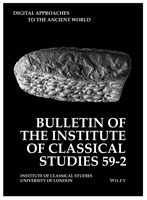
Digital Approaches and the Ancient World, BICS 59-2 (2016)

BICS 59-2 coverThe Bulletin of the Institute of Classical Studies is very happy to announce the publication of issue 59-2, the last issue of 2016, edited by Gabriel Bodard, Yanne Broux and Ségolène Tarte, on the theme of Digital Approaches and the Ancient World.

BICS is a print journal, published by Wiley-Blackwell, also available in electronic form to subscribers through their online library.

Section I, Near East, with articles by: J. Troy Samuels; Stéphane Polis & Vincent Razanajao.

Section II, History and Landscape, with articles by: Adam Rabinowitz et al.; Chiara Palladino; Elaine Sullivan.

Section III, Greek and Latin, with articles by: Neel Smith; Gloria Mugelli et al.; Monica Berti et al.; Justin A. Stover & Mike Kestermont.

Contents at Wiley Online Library: https://doi.org/10.1111/bics.2016.59.issue-2

Posted in Open Access, Publications | Leave a comment

EpiDoc training workshop, London, April 2017

We invite applications to participate in a training workshop on digital editing of papyrological and epigraphic texts, at the Institute of Classical Studies, London, April 3–7, 2017. The workshop will be taught by Gabriel Bodard and Lucia Vannini (ICS) and Simona Stoyanova (KCL). There will be no charge for the workshop, but participants should arrange their own travel and accommodation.

EpiDoc: Ancient Documents in XML

EpiDoc (epidoc.sf.net) is a community of practice and guidance for using TEI XML for the encoding of inscriptions, papyri and other ancient texts. It has been used to publish digital projects including Inscriptions of Aphrodisias and Tripolitania, Duke Databank of Documentary Papyri, Digital Corpus of Literary Papyri, and EAGLE Europeana Project. The workshop will introduce participants to the basics of XML markup and give hands-on experience of tagging textual features and object descriptions, identifying and linking to external person and place authorities, and use of the online Papyrological Editor tool.

The workshop will assume knowledge of papyrology or epigraphy; Greek, Latin or another ancient language; and the Leiden Conventions. No technical skills are required, and scholars of all levels, from students to professors, are welcome. To apply, please email gabriel.bodard@sas.ac.uk with a brief description of your background and reason for application, by February 14, 2017.

(Revised to bring back deadline for applications to Feb 14th.)

Posted in EpiDoc, Events, Teaching | Leave a comment