
Heritage Placement Report: 3D imaging in the Institute of Classical Studies
Guest post by Nori Tang, Durham University
Last summer I joined a two-week placement at the Institute of Classical Studies (ICS) as part of the Roman Society’s Museum and Heritage Summer Placement Scheme. Under Dr. Gabriel Bodard’s supervision, I worked on photogrammetry and Reflectance Transformation Imaging (RTI) of objects from the Ehrenberg Collection. The aim was to create clear and accessible digital models of the Ehrenberg Collection and upload them to Sketchfab, continuing earlier work with 3D photogrammetry.
The Ehrenberg Collection was left to the ICS by Dr. Victor Ehrenberg in 1976. It contains over 150 small antiquities, mainly Greek and Roman ceramics, ranging from the Minoan to Byzantine periods. These objects have been documented in different ways: handwritten catalogues with sketches, typewritten descriptions with photographs, and, more recently, 3D models made through photogrammetry. 3D models allow users to view an object from all angles, share it online, and even 3D print (more or less) accurate replicas, making the collection more accessible for study and teaching.
Before this placement, I had gained some hands-on experience with 3D photogrammetry and RTI as part of my Data Science (Digital Humanities) MSc at Durham University. Most of this work was outdoors, such as recording gravestones in a local graveyard project. While these activities gave me a good understanding of the basic workflow, my practice had been occasional rather than regular.
During the placement, I worked on 3D photographing of a wide range of objects from the Ehrenberg Collection in the Senate House MakerSpace. Each piece came with its own challenges, which led me to practise different aspects of photogrammetry and problem-solving.
The first object was a Gandharan Bodhisattva head (catalogue no. 66), which I worked on together with Aimée Wilkinson (the other student on the SPRS placement, whose report is here). The modelling process went smoothly and finally we decided to take the experiment further by 3D printing and turning it into a fridge magnet. This was a good way to see how cultural heritage objects could be adapted for creative outreach. Another object was an Italian Kylix (catalogue no. 68) — a small kylix with black slip and red painted decoration of tongues and leaves. The surface had a slight reflective quality, and its size made it difficult to handle, especially with its two small handles. I also worked on a Sherd (catalogue no. 47.xii) — a light tan pottery fragment painted black on both sides. The sherd was both small and thin, with a reflective painted surface. Controlling the lighting was especially important here to avoid overexposure on the black paint while keeping the incised decoration visible.
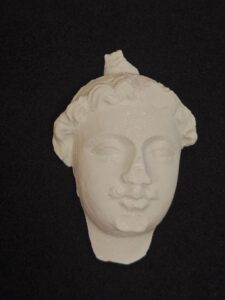
Figure 1: 3D printed magnet of Gandharan Bodhisatva head.

Figure 2: The slightly reflective Kylix, with the shining part appearing hollow in Agisoft Metashape.
The most challenging object was a bronze coin (catalogue no. 78), which was difficult to focus on and required occasional manual adjustments as the turntable rotated. At first, I tried fixing the coin between two pieces of adhesive putty. However, as the turntable rotated, the coin gradually tilted, making the photographs inconsistent. To solve this, I made a simple support device by cutting a small slit into a piece of foam and placing the coin inside. This worked well to stabilize the coin for capturing the upper half of the model, with the lens set to a focal length of f/20 and the ISO at 400. Unfortunately, the underside of the coin was less successful. When I tried merging the two halves, the alignment was poor, and the final 3D model was not satisfactory. At this point, I decided to switch to RTI, which we also practiced this week, and which is particularly good for capturing fine surface details and inscriptions on flat objects like coins. RTI revealed surface patterns that were hard to see in normal photographs, showing its value as a complementary method to photogrammetry.

Figure 3: Data collection. a) Coin supported in a DIY foam stand.

Figure 3: Data collection. b) Positions of the angles used to capture the upper part of the coin.

Figure 4: snapshot of RTI of the coin, showing fine surface details.
Comparing photogrammetry and RTI shows that each method has its strengths. Photogrammetry works best for making full 3D models of objects with complex shapes, while RTI is especially good at capturing subtle surface details, particularly on flat, reflective, or worn items. Although RTI doesn’t produce a full 3D scan, it makes surface textures and relief much easier to see than conventional photos. This helps reveal marks, inscriptions, and indentations, making objects easier to read, study scientifically, and present in an engaging way. Since the Ehrenberg Collection includes other coins, RTI could be a valuable tool for documenting them in the future.
By working on such a variety of objects, I gained a deeper understanding of the technical adjustments needed for different materials and shapes. I also became more confident in adapting my approach when the first attempt did not work as planned.
I am grateful to the Roman Society for supporting this placement. And I would like to express my sincere thanks to Gabby for his patient guidance and encouragement throughout the project. In addition, I am thankful to everyone at the Institute of Classical Studies for creating such a welcoming and supportive environment, and I especially appreciated Katie Boulton the institute manager inviting us to the ICS Library Staff end-of-year party, as their kindness made it easy for me to settle in and feel part of the team.
