
Web/Database Job at UPenn Museum

[Note: I have no official connection to this posting but can vouch for C. Brian Rose as a great person to work with. -Sebastian]

GORDION DATABASE AND WEB DEVELOPER


“The Gordion Database and Web Developer is a one-year term position with the possibility of renewal that reports to the Curator-in-Charge of the Mediterranean Section and is responsible for the design and implementation of the Gordion Project’s digital resources. These include the back-end database which uses open-source software and the public website housed at https://sites.museum.upenn.edu/gordion/. The Gordion Project in central Turkey has been active since the 1950s and has collected a substantial and growing archive of paper-based and digital information. A significant portion of this archive has been digitized and is available in a content management system. This material is currently used by researchers working to publish the excavation’s results. The project is also committed to sharing this data via its website. The Gordion Database and Web Developer will work with the Gordion Project Archivist to facilitate both internal use and public access. The Gordion Database and Web Developer will also be responsible for database development for ongoing field research in Gordion. Participation in fieldwork at Gordion is also desirable.”

Full posting: https://jobs.hr.upenn.edu/postings/4014
Posted in General | Leave a comment

Editing Texts and Digital Libraries: 2 seminars in Leipzig

Posted for Greta Franzini:

Next week the Humboldt Chair of Digital Humanities is hosting two seminars as part of its Digital Philology course:

1) Monday May 19th, 3:15-4:45pm, University of Leipzig (Paulinum, room P801)
“Editing Texts in Context: Two Case Studies” by Rebecca Finnigan, Christine Bannan and Prof. Neel D. Smith, College of the Holy Cross

2) Tuesday May 20th, 9:15-10:45am, University of Leipzig (Paulinum, room P801)
“digilibLT – a Digital Library of Late Latin Texts” by Prof. Maurizio Lana, Università del Piemonte Orientale (Italy)

For more information, please visit https://www.dh.uni-leipzig.de/wo/news-announcements/

Posted in Digital library, seminar | Leave a comment

SNAP:DRGN introduction

Standards for Networking Ancient Prosopography: Data and Relations in Greco-roman Names (SNAP:DRGN) is a one-year pilot project, based at King’s College London in collaboration with colleagues from the Lexicon of Greek Personal Names (Oxford), Trismegistos (Leuven), Papyri.info (Duke) and Pelagios (Southampton), and hopes to include many more data partners by the end of this first year. Much of the early discussion of this project took place at the LAWDI school in 2013. Our goal is to recommend standards for sharing relatively minimalist data about classical and other ancient prosopographical and onomastic datasets in RDF, thereby creating a huge graph of person-data that scholars can:

  1. query to find individuals, patterns, relationships, statistics and other information;
  2. follow back to the richer and fuller source information in the contributing database;
  3. contribute new datasets or individual persons, names and textual references/attestations;
  4. annotate to declare identity between persons (or co-reference groups) in different source datasets;
  5. annotate to express other relationships between persons/entities in different or the same source dataset (such as familial relationships, legal encounters, etc.)
  6. use URIs to annotate texts and other references to names with the identity of the person to whom they refer (similar to Pelagios’s model for places using Pleiades).

More detailed description (plus successful funding bid document, if you’re really keen) can be found at <https://snapdrgn.net/about>.

Our April workshop invited a handful of representative data-holders and experts in prosopography and/or linked open data to spend two days in London discussing the SNAP:DRGN project, their own data and work, and approaches to sharing and linking prosopographical data in general. We presented a first draft of the SNAP:DRGN “Cookbook”, the guidelines for formatting a subset of prosopographical data in RDF for contribution to the SNAP graph, and received some extremely useful feedback on individual technical issues and the overall approach. A summary of the workshop, and slides from many of the presentations, can be found at <https://snapdrgn.net/archives/110>.

In the coming weeks we shall announce the first public version of the SNAP ontology, the Cookbook, and the graph of our core and partner datasets and annotations. For further discussion about the project, and linked data for prosopography in general, you can also join the Ancient-People Googlegroup (where I posted a summary similar to this post earlier today).

Posted in Projects, report | Tagged , , , | Leave a comment

Ontologies for Prosopography: workshop at DH 2014, Lausanne (July 8)

Digital Humanities 2014: Workshop
Lausanne, Switzerland
8th July, 2014

To register, go to the Digital Humanities 2014 website.

Ontologies for Prosopography: Who’s Who? or, Who was Who?

Linked data has become an increasingly popular fixture in digital humanities research because it offers a way to break out of the data silos that are constantly being created, and provides a framework for new ways of approaching research questions. Tim Berners-Lee’s four principles of linked data, however, remind us that global identifiers for entities – URIs – provide only a part of what is needed if linked data is to fulfil its promise.  As much as possible, we also need common semantic frameworks to better tie the data together – what are called “ontologies”.

In a seminal paper way back in 1993 Thomas Gruber defined an ontology as an “explicit specification of a shared conceptualisation”. We will be focusing on possibilities for an ontology for prosopography because, for historical data at least, people, places and textual sources are likely to be the three pillars upon which a structure of linked data can be constructed, and these three things are likely to be the primary entry point for a collection of linked historical data. While methodologies for dealing with textual sources are being continually refined, the success of the Pelagios project has demonstrated how historical geographic information, in this case classical, can be used to bring together a wide variety of projects. This workshop will address the issues of bringing linked data to the description of historical persons with the morning session devoted to exploring the question of whether there are sufficient common concepts – a shared conceptualisation – to enable for the practical and useful development of an ontology for historical persons, and the afternoon addressing the challenges of linking these descriptions together to create a shared resource.

Continue reading

Posted in Conferences | Leave a comment

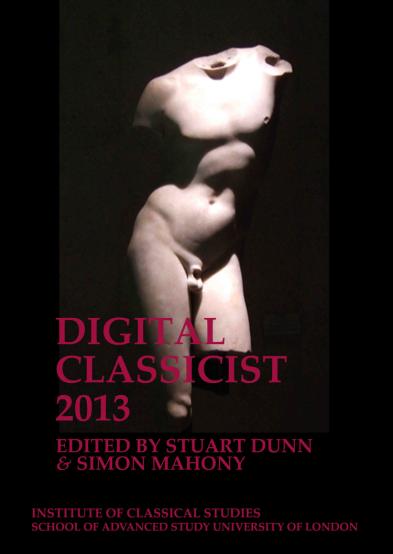
BICS Supplement 122: THE DIGITAL CLASSICIST 2013

We are very pleased to announce the publication of the latest Digital Classicist volume, The Digital Classicist 2013, published by the Institute of Classical Studies, London as part of their BICS series.

This edited volume collects together peer-reviewed papers that initially emanated from presentations at Digital Classicist seminars and conference panels.

For full details see the publisher’s site, and the Open Library of the Humanities where the supplement is now open access.

Please ask your library to order a copy.

Posted in Publications | 6 Comments

Digital Classicist London seminars, 2014

Digital Classicist London & Institute of Classical Studies Seminar 2014

Fridays at 16:30 in room G37* Senate House
Malet Street, London, WC1E 7HU
* Unless otherwise specified below

June 6* Ségolène Tarte (Oxford), On Cognition and the Digital in the Study of Ancient Textual Artefacts 103 (Holden Room)
June 13* Victoria Moul & Charlotte Tupman (King’s College London), Neo-Latin poetry in English manuscripts, 1550-1700 103 (Holden Room)
June 20 Lorna Richardson (University College London), Public Archaeology in a Digital Age
June 27 Monica Berti, Greta Franzini & Simona Stoyanova (Leipzig), The Leipzig Open Fragmentary Texts Series and Digital Fragmenta Historicorum Graecorum Projects
July 4* Pietro Liuzzo (Heidelberg), The Europeana network of Ancient Greek and Latin Epigraphy (EAGLE) and Linked Open Data 102 (Athlone Room)
July 11 Silke Vanbeselaere (Leuven), Retracing Theban Witness Networks in Demotic Contracts
July 18* Thibault Clérice (King’s College London), Clotho: Network Analysis and Distant Reading on Perseus Latin Corpus G34
July 25* Marja Vierros (Helsinki), Papyrology and Linguistic Annotation: How can we make TEI EpiDoc XML corpus and Treebanking work together? G35
Aug 1 Sebastian Rahtz (Oxford) & Gabriel Bodard (King’s College London), Standards for Networking Ancient Prosopographies: Data and Relations in Greco-Roman Names (SNAP:DRGN)
Aug 8 Dominic Oldman & Barry Norton (British Museum), A new approach to Digital Editions of Ancient Manuscripts using CIDOC-CRM, FRBRoo and RDFa
Aug 15 Various postgraduate speakers, Short presentations

ALL WELCOME

The seminar will be followed by wine and refreshments.

For more information please contact Gabriel.Bodard@kcl.ac.uk, Stuart.Dunn@kcl.ac.uk, S.Mahony@ucl.ac.uk or Charlotte.Tupman@kcl.ac.uk, or see the seminar website at https://www.digitalclassicist.org/wip/wip2014.html

Posted in seminar | 1 Comment

Artistic practice and language learning, Grenoble, Jan 28-30, 2015

Call for papers

International symposium, within the context of
ARC 5 – Cultures, Sciences, Sociétés et Médiations
Rhône-Alpes Region (France)
Operation Fabula agitur !

Fabula agitur !
Theatrical and artistic practices, oracy, and the learning of Ancient Languages and Cultures
History, Aesthetics, Didactics

Grenoble University (France), January 28-30, 2015

In recent years, specialists in language instruction have paid much attention to the contribution of theatrical practices – and, more broadly speaking, of artistic practices – to the learning of modern languages. This symposium intends to look into a body of work that has so far been neglected: artistic practices used as a way to teach Ancient Languages, whether at school, college, or in local associations, in France and abroad.

For a long time now, however, there have been many examples of such practices. The Educational Theatre of Jesuit colleges, used from the sixteenth century onwards, is one of the most famous examples. Indeed, this type of practice is remarkable because of its wide audience as well as its ‘holistic’ educational approach. Nowadays, Ancient Language teachers may organize Olympiades, tiny drama workshops, unpolished performances or even erudite pageants to provide their pupils with a different approach to Ancient Languages and Cultures. Thanks to the stage, acting and oracy, this approach may be more physical and more emotional than those they are used to encountering in the classroom, in terms of what the Common European Framework of Reference for Languages (CEFR) calls “knowledge”, “skills” and “existential competences” (three macro-categories that apply to each form of learning).

The symposium will be held at Stendhal University – Grenoble III (France) from January 28 to January 30, 2015. Conference participants will be offered short training sessions on Ancient Language theatre as well as two theatrical performances which will clearly display the benefits of artistic practices for the learning of Ancient Languages and Cultures.

Communication and workshop proposals should be sent to Malika Bastin-Hammou (Malika.Bastin@u-grenoble3.fr) and Filippo Fonio (Filippo.Fonio@u-grenoble3.fr) before July 01, 2014. They should be written as a presentation, and not exceed 1,500 characters. Scientific committee decisions will be made available on October 01, 2014 at the latest.

Appel à communication-Fabula agitur (PDF: French & English)

Posted in Call for papers, Conferences | Leave a comment

TEI Hackathon workshop at DH2014 (July 7)

Call for Participation

We are inviting applications to participate in the TEI Hackathon full day workshop that will be held on July 7, 2014, as a pre-conference session at DH2014 (https://dh2014.org/).

Digital humanists, librarians, publishers, and many others use the Text Encoding Initiative (TEI) Guidelines to mark up electronic texts, and over time have created a critical mass of XML — some conforming to known subsets of the TEI Guidelines, some to individual customizations; in some cases intricate and dense, in others lean and expedient; some enriched with extensive external  metadata, others with details marked explicitly in the text. The fruits of this labor are most often destined for display online or on paper (!), indexing, and more rarely, visualisation. Techniques of processing this markup beyond display and indexing are less well-understood and not accessible to the broad community of users, however, and programmers sometimes regard TEI XML as over-complex and hard to process.

What We’ll Do

The goal of the hackathon is to make significant progress on a few projects during one day of work (from 9am to roughly 5.30pm). Continue reading

Posted in Conferences, Open Source | Leave a comment

Postdoc in digital history at Washington & Lee

Posted for Rebecca Benefiel:

Mellon Junior Faculty Fellow in Digital History

Washington and Lee University invites applications for a Mellon Foundation postdoctoral fellowship for recent Ph.D.s in history who intend to pursue careers as teacher-scholars in a liberal arts college setting. These two-year fellowships are open to candidates who earned their Ph.D.s in Spring 2012 or later. Fellows will play an active role in helping to demonstrate innovative methods of teaching, making interdisciplinary connections and teaching new courses in neglected areas of the curriculum. Fellows will have a reduced teaching load to allow time for their own scholarly development.

The Department of History seeks a specialist in digital history with a concentration in ancient or any field in pre-1800 global or non-Western history. Applicants should have experience with digital humanities pedagogies and using digital humanities tools in their scholarly research.

Apply electronically at our portal: https://jobs.wlu.edu/postings/1907. After filling out a cover sheet, you will be prompted to upload a letter of application, a CV, a sample of recent scholarly work, and enter contact information for two providers of letters of recommendation (or a credentials file). Review of applications will begin April 7, 2014. Address your application letter (and any questions) to Professor Sarah Horowitz (horowitzs@wlu.edu), Chair, Mellon Junior Faculty Fellow in Digital History Search Committee, Department of History, Washington and Lee University, Lexington, VA 24450. Washington and Lee and the Department of History are interested in candidates committed to high standards of scholarship and professional activities, and to the development of a campus climate that supports equality and diversity among its faculty, staff, and students. The University is an Equal Opportunity Employer.

Posted in Jobs | Leave a comment

CFP: Digital Classicist London seminar series 2014

We have had requests for a few days’ extension to the deadline for abstracts and consider it only fair to extend that to everyone. To submit a proposal, email an abstract of approximately 500 words to s.mahony@ucl.ac.uk by midnight UTC on March 16th, 2014

See earlier CFP for full details.

Posted in Call for papers, seminar | Leave a comment

Course on Digital Data and Archaeology: Management, Preservation and Publishing

Via an email from Katie Green to the Antiquist list:

Digital Data and Archaeology: Management, Preservation and Publishing
Mon 3 to Tue 4 Mar 2014
Rewley House 1 Wellington Square Oxford OX1 2JA

Through a series of presentations, practical sessions and group discussions, this course will explore the importance of digital preservation for the long term safety of archaeological data and provide practical guidance on how to prepare, curate, deposit and access digital data. The course will also provide guidance on data publishing online and introduce Linked Open Data for archaeology. The course is aimed primarily at archaeology data creators and data curators operating in national agency and local authority heritage environments. However this course will also be of benefit to professionals working in commercial, independent and research environments and to community groups utilising and creating archaeological data. The course will be of particular interest to those who maintain large data sets and need to efficiently manage, effectively preserve and provide access to their data for the future.

More details available here: https://www.conted.ox.ac.uk/courses/details.php?id=V400-325&Category=800
If you have any questions about this course, please email professional.arch@conted.ox.ac.uk.

Posted in General, seminar | Leave a comment

Part-time, fixed-term IT job in British Museum

A job ad that might suit a digital classicist or archaeologist with good programming skills (Python, PHP, Java) looking to work part-time, perhaps while studying or freelancing, is being circulated by Dan Pett of the Portable Antiquities Scheme in the British Museum. It may be a sign of the tough climate that a limited contract like this is offered to someone with this kind of expertise and interests, but if it does suit the shape of your life at the moment, the PAS are a great team to work with!

The British Museum is currently recruiting for an ICT Officer in the Britain, Europe and Prehistory Department on a fixed term part-time basis working 3 days per week. The ICT Officer will provide assistance to the ICT Adviser for further development of the Portable Antiquities Scheme (PAS) website and database, with system maintenance and monitoring of data flow. You will ensure data standards are maintained, providing a secondary point of contact for technical enquiries from the general public and PAS staff. You will be fully trained to run the PAS database and will gain experience of managing the PAS ICT infrastructure.

See full job and applications details.

Posted in Jobs | Tagged , | Leave a comment

CFP: Making Meaning from Data

Abstracts are invited for the Digital Classics Association colloquium at SCS / AIA Annual Meetings in New Orleans, Louisiana, January 8-11, 2015.

[[ reposted from https://apaclassics.org/annual-meeting/146/cfp-making-meaning-data ]]

Sponsored by the Digital Classics Association
Organizers: Neil Coffee, University at Buffalo, SUNY; Gregory Crane, Tufts University; Christopher Blackwell, Furman University; Jeffrey Rydberg-Cox, University of Missouri Kansas-City

Digital techniques hold the promise of providing a consistent and comprehensive basis for the interpretation of classical culture, yet they also raise significant questions of method. Do digital approaches lead us away from certain kinds of interpretation and toward others? How does the quantitative and aggregate nature of argumentation common to digital humanities relate to other modes of understanding the ancient world? Papers are invited for this session that reflect theoretically on the study and understanding of classical antiquity in light of the growing importance of digital methods. Participants may take as their object material any aspect of classical culture, including, but not limited to: history, language, literature, material and visual culture, and philosophy.

Anonymous abstracts of no more than 400 words should be sent to digitalclassicsassociation@gmail.com, with identifying information in the email. Abstracts will be refereed anonymously by three readers in accordance with APA regulations. In your email, please confirm that you are an APA member in good standing. Abstracts should follow the formatting guidelines of the instructions for individual abstracts on the APA website. The deadline for the submission of abstracts is 5 p.m. Eastern Time, February 3, 2014.

Contact: Neil Coffee, University at Buffalo, SUNY, ncoffee@buffalo.edu

Posted in Call for papers, General | Leave a comment

EpiDoc Workshop, London, April 28-May 1, 2014

We invite applications for a 4-day training workshop on digital editing of epigraphic and papyrological texts, to be held in the Institute of Classical Studies, London, April 28-May 1, 2014. The workshop will be taught by Gabriel Bodard (KCL), Simona Stoyanova (Leipzig) and Charlotte Tupman (KCL). There will be no charge for the teaching, but participants will have to arrange their own travel and accommodation.

EpiDoc (epidoc.sf.net) is a set of guidelines for using TEI XML (tei-c.org) for the encoding of inscriptions, papyri and other ancient documentary texts. It has been used to publish digital projects including the Inscriptions of Aphrodisias, the US Epigraphy Project, Vindolanda Tablets Online and the Duke Databank of Documentary Papyri. The workshop will introduce participants to the basics of XML markup and give hands-on experience of tagging textual features and object descriptions in TEI, as well as use of the tags-free Papyrological Editor (papyri.info/editor).

No technical skills are required, but a working knowledge of Greek or Latin, epigraphy or papyrology and the Leiden Conventions will be assumed. The workshop is open to participants of all levels, from graduate students to professors or professionals.

To apply for a place on this workshop please email charlotte.tupman@kcl.ac.uk with a brief description of your reason for interest and summarising your relevant skills and background, by Friday February 21st, 2014.

Posted in EpiDoc, Teaching | Leave a comment

CFP: Digital Classicist London seminar series 2014

The Digital Classicist London seminars have since 2006 provided a forum for research into the ancient world that employs digital and other quantitative methods. The seminars, hosted by the Institute of Classical Studies, are on Friday afternoons from June to mid-August in Senate House, London.

We welcome contributions from students as well as from established researchers and practitioners. We welcome high-quality papers discussing individual projects and their immediate context, but also accommodate broader theoretical consideration of the use of digital technology in Classical studies. The content should be of interest both to classicists, ancient historians or archaeologists, and to information specialists or digital humanists, and should have an academic research agenda relevant to at least one of those fields.

There is a budget to assist with travel to London (usually from within the UK, but we have occasionally been able to assist international presenters to attend).

To submit a proposal for consideration, email an abstract of approximately 500 words to s.mahony@ucl.ac.uk by midnight UTC on March 16th, 2014. (Note new deadline.)

Further information and details of past seminars are available at: www.digitalclassicist.org/wip

Posted in Call for papers, seminar | Leave a comment